
Erica Richards led us in an ideation exercise based on the book,
How to Do Nothing: Resisting the Attention Economy by Jenny Odell
Erica asked us:
- What do You Pay Attention To?
- Do a one minute presentation on what do you pay attention to.
- Use five Minutes to Prepare for the Presentation.
- Then, give a “Call for Action!”
- Then, participants do the call.
HERE’S WHAT WE PAY ATTENTION TO
Katie pays attention to unknown places. She told us how she led a group on a dérive, a practice conceived by the French “Situationists.” Basically a derive is an aimless, stream-of-consicous kind of walking through a place in which you ignore all the official and rational methods for navigating through that place. For instance, the Situationists would use a map of one city to journey through another city. In Katie’s story, she told us how her group flipped a coin every time they came to a corner to know to go left or right.
Katie’s Call to Action: Put yourself in a place you’ve never been and take a photograph of it. Post your photo to #actionfigur3s.
Amy pays attention to a lot of things: positive outlooks, humor in unexpected places, all things botanical and floral, a growth mindset and related books, all things art ed related, kindness in people, sunsets, intuitive and mindfulness practices.
Amy’s Call to Action: Make a humorous picture to give to someone as a random act of kindness.
Dale pays attention to how space and people flow. She thinks about the spaces where she and others work. This week she redesigned a layout in her classroom clay area. She added more tables to add flow and movement.
Dales Call to Action: Pick one place in your life lacking in flow and resolve it.
Christy pays attention to her phone. She was thinking about her phone and she’s addicted to it.
Christy’s Call to Action: Do something unplugged and non-digital.
Rachael pays attention to difficult math because she has been using it in her artwork.
Rachael’s Call to Action: Photograph things that are oblique and simultaneously beautiful, like Where Theory Meets Chalk Dust Flies.
Elizabeth pays attention to gratefulness.
Elizabeth’s Call to Action: Record how many times a day you thanked someone are they a friend, close family member, or stranger. Collect this data for a week. (see Dear Data)
Jesse pays attention to the lines in architecture….lines that go immediately up and then lead down to the foundation of a building and then what else in the ground underneath.
Jesse’s Call to Action: Imagine what is 20 feet below you right now.
Pat pays attention to faces and bright colors. Emojis!
Pat’s Call to Action: Create an emoji on how you are feeling right now
Anne pays attention to the unfinished projects in her house.
Anne’s Call to Action: When you go to bed at night and you are worried about something, take comfort in the fact that there are four solid walls and a floor and ceiling surrounding you.
Beatrice pays attention to people’s faces when their art is being critiqued in class.
Beatrice’s Call to Action: Be aware of someone’s reaction to the thing you say to them.
Then we looked at ideation resources, that teachers brought.
IDEATION RESOURCES
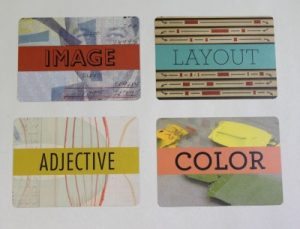
Abecedarian Gallery sells the Adjective and Media card set by artist Julie Chen
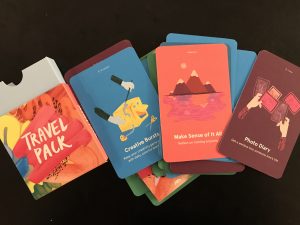
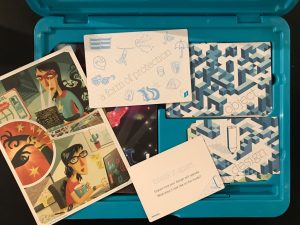
Design Challenge Box by The Activity Hub

Your Ideas Start Here by Caroline Eckert
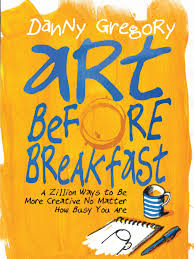
Art Before Breakfast by Danny Gregory
Cooper Hewitt Ready, Set, Design
NEXT MEETING, NOV. 13, WE’LL DIG IN.
Rachael and Anne will facilitate exercises and conversation about combinatory thinking, the element that is present in so many of the above ideation resources. We’ll examine the ways we combine things in creative thinking: HOW things are combined and WHAT things are combined. We’ll discuss the implications this has on innovation. See you then.