November 14, 2018 TEACHER SHARE

Here are some of the teacher projects and ideas that we talked about tonight.

PROJECT SHARED: IDENTITY ARTIFACTS (Jenny Drake)
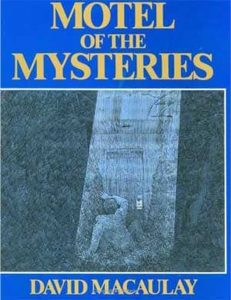
Jenny’s students investigate time and cultural artifacts. She first brought “a bunch of junk” from home and told the student that these artifacts were being curated by experts in Denver. They discussed the meaning and definition of “artifact.” Then they investigated Motels of the Mysteries by David Macaulay (PDF Summary). Students were challenged to make an artifact that represents who they are, so when someone 200 years from now comes along, those people will be able to use the artifact to learn who the student was. The challenge was to communicate their identity in an authentic way, so that their identity wouldn’t be misinterpreted 200 years from now. Students used different media, including soap carving.

JENNY’S QUESTION TO OUR GROUP AND THEIR RESPONSES: How can the ideation process be more robust for this project?

Ideation Exercise Idea: “Playful Excavation” Place obscure objects in a box of sand for student archeology groups to discover. From the mysterious artifact, students ask questions, infer meaning, and write a story about it.

Ideation Exercise Idea: Take an everyday object and answer the prompt: If someone found this 200 years from now, what would they think it was? A fun resource could be: Viral videos of children exploring cassette players.

Ideation Exercise Idea: Archeologists explore trash heaps. What is in our trash reveals our lives. It may be interesting to ask the question, if someone saw in your garbage, what would they find? What would it say about you? Could you do a garbage investigation in the school?


PROJECT SHARED: WHAT MAKES CULTURE? AND WHO DECIDES? (Laurie Edmonstone)

Everybody has a culture and even though sometimes seems like you don’t at first, it is there. Students started with a mind map. First of all what is a mind map. Tangent! The episode on mind mapping with Good Mythical Morning Youtubers…two dudes who do a show on really interesting stuff like, “Will it Shoe?…making shoes out of books, meatloaf, etc” or “Will it corndog?…hybridizing corndogs with other things, like sushi. Check them out.

We digress.

Back to the project. As students “mind-mapped” their culture, they researched what others say about their culture: What do the so-called experts have to say about their culture?, What does google images have to say about their culture?, etc.

Then they moved into personal identity, looking at artists who address identity in artworks: Alessandra Ross, Kip Omolad, etc. This project is just beginning.

PROJECT SHARED: ALTERED BODY (Jesse Bott)
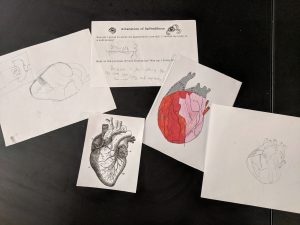
Jesse’s 5th grade project integrates with human body curriculum from other classrooms. Students made body alterations based on the prompts, “If you could change anything about your body, what would you do? Would you alter your body for a belief? Enhance it for any particular reason?” Students brought their research about what they learned about our bodies and what they know about themselves. Students came up with alterations to run faster, jump higher, extend further, become a strength-protector, and morph into the natural world.

SKETCHFOLIOS

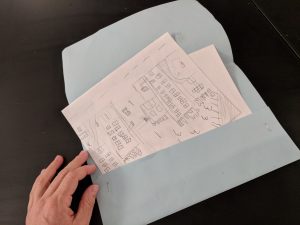
This led to a conversation about student sketch books. Because Jesse noticed that students needed to look at more than one research page at a time in their sketch books, he came up with a   “sketchfolio.” This is basically a 17″x11″ piece of paper quarter-folded to make a pocket. Students make one sketchfolio per project to keep track of and access their process drawings and research.
INTEGRATION

 That moved into a conversation about integration. What are the issues around this?

TIMING and TIME Do your schools give you time to collaborate with other disciplines or do they expect you to find the time on your own? There is a problem in the timing. Sometimes you find out what other teachers are doing and the collaboration is too late.

ART-TEACHER-IT-UP Educating your classroom teachers is an issue. What do you do when other classroom teachers want to collaborate but their idea for the “art project” is inauthentic and thin? You take the suggestion and then, as Jenny says, you art-teacher it up.  Here are some examples from Jesse.

  • Teachers requested an integration with a butterfly study. The art teacher bypassed the usual elementary school-art-style project and had students use their knowledge of butterflies and other insects to create hybridized new creatures. The 3D work was displayed in Mark Dion-esque boxes, like an old, natural history display.
  • Teachers requested a multi-cultural art project e.g. Chinese Lanterns. The art teacher bypassed this offer and partnered with another teacher who was game to for students to create art based on a rich investigation in the symbols of their own culture and community.

CRAFT

This led to a conversation on beauty and craftsmanship. How do you show classroom teachers  the lack of learning and the inauthenticity of a weak art project idea, while still honoring their need to have pretty artworks for the halls?  What can art teachers do to help kids think deeply, yet still build media skills? How can you scaffold for smart student art work that is also beautiful?

DOCUMENTATION OF STUDENT THINKING

This led to a conversation on documentation of student thinking in the hall. One art teacher only shows process in the hall, no final products. Documentation as a Reggio Emilia practice shows the process along with the final product. How do you compose the documentation board in a way to shows both?

GETTING HIGH SCHOOL STUDENTS TO OWN THEIR RUBRIC CRITERIA

We swayed to a conversation about rubrics. Laurie shared how she gives students overarching categories like “idea” and “execution.” Then she tells students about the project and media and asks them, “How would you fail at them?” Students envision how they would fail. Together students and teacher created the “beginning” or low bar column for the rubric. From that bad list they move to the better work.  “Let’s make the good end.” Finally after the basic criteria column is written, Laurie leaves the last “Exceeds Expectations” column blank, intending for students to fill that in if they think their finished work does exceed expectations, going beyond the minimum expectation. Written with students.

Another effective High School assessment strategy: Laurie posts the final grades of a project, omitting the students’ names. For instance: Period one’s ceramic project had 5 A’s, 9 B’s, 3 C’s, 5D’s. That way students can privately see where their performance is situated within the entire class score. This gives students confidence and reassurance as well as a wake up call.

FYI, Susan Brookhart is Anne’s go-to scholar when it comes to meaningful rubrics.

S. Brookhart Misconceptions about Rubrics


TEACHING ABROAD!

Laurie sold her house and is moving her family to China for two years to teach art in Shanghia via Teaching Nomad.  If you have questions about international teaching, reach out to Laurie via the TLP email group.
Finally….over Thanksgiving break, go see the Tara Donavan show at MCA! Several teachers tonight raved about it.

See you in January!


October 10, 2018 TEACHER SHARE

We had a great night sharing projects, student work, resources, and asking questions.


PROJECTS 

Accordion Book about The Secret Life of Trees, 5th grade, Christy Loher

What do trees mean to you? What secrets do trees have?

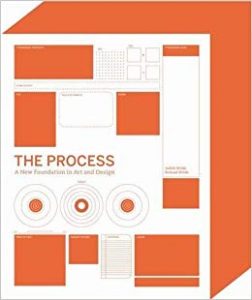
Notebook Paper Exercise from The Process , 10th grade, Erica Gonzolas

Transforming the design (blue and red lines, holes) of notebook paper to express concepts and emotions

.

RESOURCES that emerged from our discussion

The Process:A New Foundation in Art and Design, Wilde&Wilde (college exercises that can be translated to lower grades)

The Secret Lives of Fruits and Vegetables, Maciek Jasik

Fiskars Huge Circle Hole Punch 

How do Trees Collaborate? Podcast about Trees Talking to Each Another

Christine Odlund: Visualizing and recording the language of plants

Object Empathy Art Assignment Diana Shupungin Repairing the world

The Sketchbook Project A diverse and abundant on-line archive of sketchbooks

Virtual Reality Tours of Ancient Egypt


QUESTIONS
How do students show the art history content that they learned from virtual tours?

What successful projects have you done that work with Kindergartners?

How do you create a rubric with students?

FEATURED ARTIST

Francis Alÿs is a painter and performance artist who works with boundaries, politics, poetry.

Set Theory Exchanging artwork with local sign painters to repaint the image…Alÿs explains, “I commissioned various sign painters to produce enlarged copies of my smaller original images. Once they had completed several versions, I produced a new ‘model,’ compiling the most significant elements of each sign painter’s interpretation. This second ‘original’ was in turn used as a model for a new generation of copies by sign painters, and so on, ad infinitum.”

Retouch/Retoque Repainting sixty yellow, fading median strips on a road in the former American Panama Canal Zone, the territory joining the Atlantic and Pacific oceans as a gesture of repair.

The Fabiola Project Finding, purchasing, and displaying 450 reproductions in flea markets of a lost 1885 painting of 4th-century Roman Saint Fabiola by French artist Jean-Jacques Henner.

The Green Line Leaking a can of green paint by tracing a line following the portion of the “Green Line” that runs through the municipality of Jerusalem.


March 7, 2018 Carlos Fresquez

Thanks to all who came to Carlos Fresquez’s artist talk. It was amazing to hear about his role in the Chicano Rights Movement, punk scene, and his continuing musical, social, and visual art collaborations. He has mentored many artists and activists in our city and is an inspiring, exemplary art educator. There is still time to view his mid-career exhibition at the CVA which closes on March 24th.


February 7, 2018 KATE THOMAS

Come to a performance/workshop by Kate Thomas, puppeteer, cantastorian, lover of teachers, disrupter of hegemony!

February 7 at 5:30

Kate Thomas is a PhD candidate at the University of British Columbia in Vancouver, Canada. Her doctoral research focuses on a site-specific practice for teachers living through the effects of neo-liberalism. She has worked with arts educators in Chicago for over 17 years, integrating the arts across the curriculum. She and her colleagues wrote the Every Art, Every Child curriculum that has been used in classrooms and teacher preparation programs for K-8th grade educators. Her artwork uses puppetry, performance, and cantastoria, a form of recitation song. She worked at Redmoon Theater, leading a visual arts and performance program for middle school girls to use stilt walking, puppetry, mentorships, and leadership for empowerment. She has also taught art education courses at the University of British Columbia, Northeaster Illinois University, and the School of the Art Institute of Chicago.

October 4th, 2017 Creative Place-making in Schools

This week we moved our focus on Creative Placemaking from the greater community to school communities. We asked members of TLP to teach us about ways that they are engaging in creative placemaking in their schools. We heard 5 great stories!

A reminder that we using the following definition of Creative Placemaking:

Creative Placemaking is an evolving field of practice that intentionally leverages the power of the arts, culture and creativity to serve a community’s interest while driving a broader agenda for change, growth and transformation in a way that also builds character and quality of place. – Artscape

We heard 5 great stories that highlighted materials, methods, spaces and routines employed by teachers. Those stories are presented in this slideshow.
(more…)

September 6, 2017 Intro to Creative Place-making

Thank you to our wonderful panel of visitors Libby Barbee, Lisa Gedguadas, Libby Barbee, Brian Corrigan and Thomas Evans (Detour).

Libby opened our year-long investigation of  Creative Placemaking by suggesting a grounding definition:

Creative Placemaking is an evolving field of practice that intentionally leverages the power of the arts, culture and creativity to serve a community’s interest while driving a broader agenda for change, growth and transformation in a way that also builds character and quality of place. – Artscape

The discussion that followed highlighted personal definitions of Creative Placemaking and we learned about the personal motivation to engage in civic minded, place based work. (more…)

Ladies of the Press

VASD

523932_10150796635694577_13839457_nMSU Denver’s Visiting Artist Scholar Designer series brings two extraordinary socially engaged artists. These two exemplify many of the ideas illustrated in The Interventionists. A few highlights of the evening include hearing about a tiny receipt printer used to document an event and simply watching the incredibly collaborative dynamic between these artists.
Home

Colorado Women of Abstraction

So happy to see you all at our first TLP meeting of the school year!

Our first session piggybacked on one of the CVA events during our Colorado Women of Abstraction Exhibition.  Jane Guthridge spoke about her work as well as created an introduction to other artists working with light as medium. She introduced us to

On September 13 at 6:30pm Gwen Chanzit, curator of Modern Art at the Denver Art Museum will be speaking on Women of Abstract Expressionism, the show currently at the CVA if anyone is interested in attending. It should be an amazing lecture!

Our next TLP meeting is Thursday 10/27. This session will also be dedicated to an artist talk. We are looking forward to hearing from  Ladies of the Press at 5:30.

Welcome Back 2016!

Hi All,
I hope you are finding your smiles despite the shortening days 🙂  And I look forward to seeing you soon!
This year TLP is taking on an investigation of site specific, socially engaged art. We also plan to create some work of our own…more on that later!

The group is entering its 6th or year, or so, and participants have asked that we flex our schedule around some other events and meetings. Please note that we will NOT be meeting on the first Tuesdays of the month this year. We will continue to meet at the CVA at 965 Santa Fe Dr. at around 5:30 however the dates are independent of one another. A schedule follows below. I apologize if our new schedule creates conflicts for anyone.

We are also incorporating more exposure to contemporary artists by encouraging attendance to our Visiting Artist Scholar Designer (VASD) lectures this year. We have incorporated the public lecture series into our meeting schedule. Those talks will inform our intervention as well! The talks begin at 6 but we thought we could still gather at 5:30 for a snack and to catch up.

During our independent meetings we will be inspired by The Interventionists. This book, a Mass MoCA publication, will serve as our guiding text. It is short and powerful! There is a brief here: http://mitpress.mit.edu/books/interventionists . We will be reading it throughout the fall semester.

Here is our schedule:

  • Tue 9/6 welcome at 5:30 at 6 pm move to gallery for Jane Guthridge presentation as part of Colorado Women in Abstraction. 
  • Wed 9/21 4:45 VASD Talk Brenden Tang
  • Thur 10/27 5:30 VASD Talk Ladies of the Press
  • Wed 11/16  5:30 Book Discussion
  • Wed 12/14 5:30  content and connections to classroom
  • Wed 1/11  5:30 Book Discussion and “Call to Action” 
  • Wed 2/15 5:30 Brainstorming and looking at action research and social action artists (potential date change)
  • Wed 3/29 4:45 pm VASD Talk Golnar Adili 
  • Tues 4/4 5:30 VASD Talk Rachel Harper  (potential date change)
  • May Dinner Morgan Pruett’s Scramble Dinner https://www.youtube.com/watch?v=JwNpuYOdFHk

I will be migrating our Weebly to a new platform at the Universities request. I will send the new address then. In the meantime you can find out more about TLP here: http://theorylovespractice.weebly.com/

Also, please invite colleagues you think might enjoy being a part of the work we are doing!
Talya

May at the CVA

We will NOT meet at the CVA on the first Tuesday of May. Instead please join us for the opening reception of our exhibition! Opening starts at 6 pm. You might find some of us at Interstate for cocktails at 5 pm.
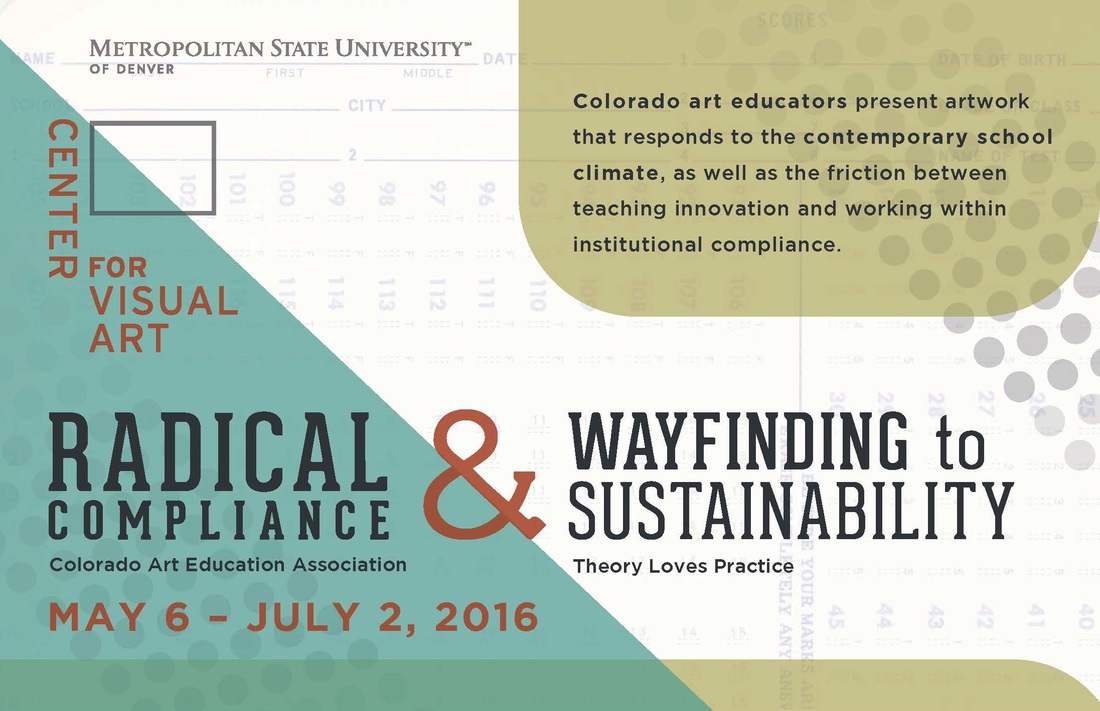
 Artists are invited to engage the public by discussing the interplay of art maker and art educator epitomized in their artwork
This event will occur on Third Friday, an evening when a typically more cogent public tours the galleries on Santa Fe. 

TASK is an improvisational event with a simple structure and very few rules. TASK’s open-ended, participatory structure creates almost unlimited opportunities for a group of people to interact with one another and their environment. TASKs’ flow and momentum depend on the tasks written and interpreted by it’s participants. (https://oliverherringtask.wordpress.com)