April Show-ers

Wayfinding to Sustainability

Opening: May 6th at 6pm
​Drop off dates:
 April 18 – 23 between the hours of 11 and 6.  Loan forms are past due.
Showcards will be available for distribution soon and we will email out a digital copy so that you can plug the show on your social media feeds.
 Congratulations to Steve and his family for the birth of their new baby!!!
​This exhibition is showing concurrently with Radical Compliance, CAEA’s annual showcase of Art teacher artwork. 

Get involved with events to increase the impact of our exhibition

May 20th we will be creating a “Living Catalog” to foster dialogue focussing on the ideas represented in the artwork. Artists are invited to engage the public by discussing the interplay of art maker and art educator epitomized in their artwork
This event will occur on Third Friday, an evening when a typically more cogent public tours the galleries on Santa Fe. 
June 3rd, we will be hosting a Task Party. TASK is an improvisational event with a simple structure and very few rules. TASK’s open-ended, participatory structure creates almost unlimited opportunities for a group of people to interact with one another and their environment. TASKs’ flow and momentum depend on the tasks written and interpreted by it’s participants. (https://oliverherringtask.wordpress.com)
​The party will take place in CVA’s parking lot from 5:30 – 8pm. This will be a First Friday and we will have around 1,500 people coming and going throughout the evening, so this should prove to be an amazing event!
June 17th and July 1st The Institute for Non-Bizarre Treatments will be hosting workshops at CVA. Katie Taft and Tracy Tomko will be leading participants in the creation of teaching tools… 

Meeting and a Caucus

Meeting recap: we discussed our ideas for the upcoming exhibition Wayfinding to Sustainability. Based on the discussions during this short meeting I can say two things for certain: 1. There are some brilliant minds in this group, and 2., our exhibition is going to have some amazing artwork!

This evening’s meeting was cut short so that we could go caucus. Seeing so many people participating in government is an amazing thing. I was filled to the gills with civic pride!

Snow Day

Dear Educators,
Due to the amount of snow that we are getting, Auraria Campus is closed for the day. As CVA is a part of MSUD and the campus, we are also closed for the day. We will reschedule TLP for the first Tuesday of March, 3/1/16. We hope that you enjoy your snow day and that we will see you at the next meeting. I will add a post soon giving you all a synopsis of what we will be doing at our March meeting. 

Looking @ Student Work: Scaffolding

In education, scaffolding refers to a variety of instructional techniques used to move students progressively toward stronger understanding and, ultimately, greater independence in the learning process. The term itself offers the relevant descriptive metaphor: teachers provide successive levels of temporary support that help students reach higher levels of comprehension and skill acquisition that they would not be able to achieve without assistance. Like physical scaffolding, the supportive strategies are incrementally removed when they are no longer needed, and the teacher gradually shifts more responsibility over the learning process to the student. (http://edglossary.org/scaffolding)
In our December meeting we critically investigated what it means to scaffold students: 
What does effective scaffolding look like?
How do we plan/implement scaffolding?
Through discussion, we concluded that scaffolding is a mode of digging deeper into the “stuff” being learned and a way of sustaining interest. Using backward design, scaffolding is built into the planning. In its most bare-boned definition, a project is planned from the final artifact backwards—examining what students need to learn in order to reach that final goal, and what evidences that learning occurred along the way. 
      
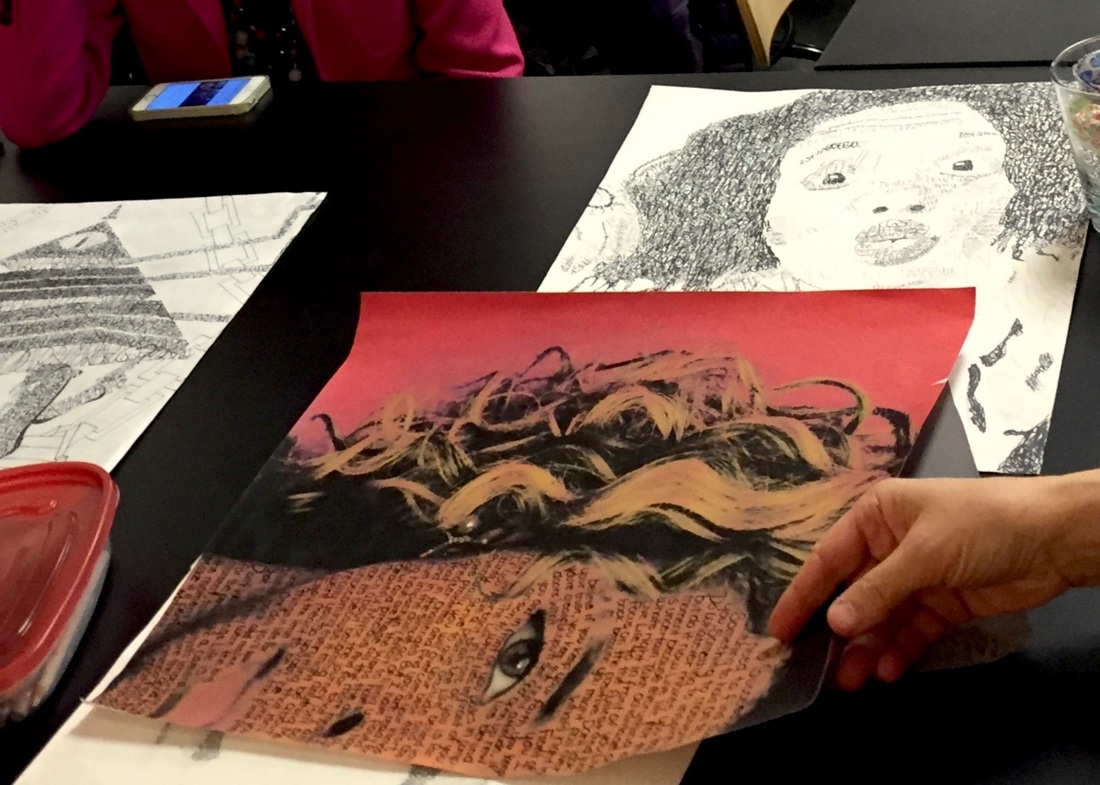
In the image above students explore the combination of image and text, how our voice adds to the interpretation of self, how text can become image, and different modes of perception. What steps do students need in order to make the leap from the written word to a self-portrait rendered in text?
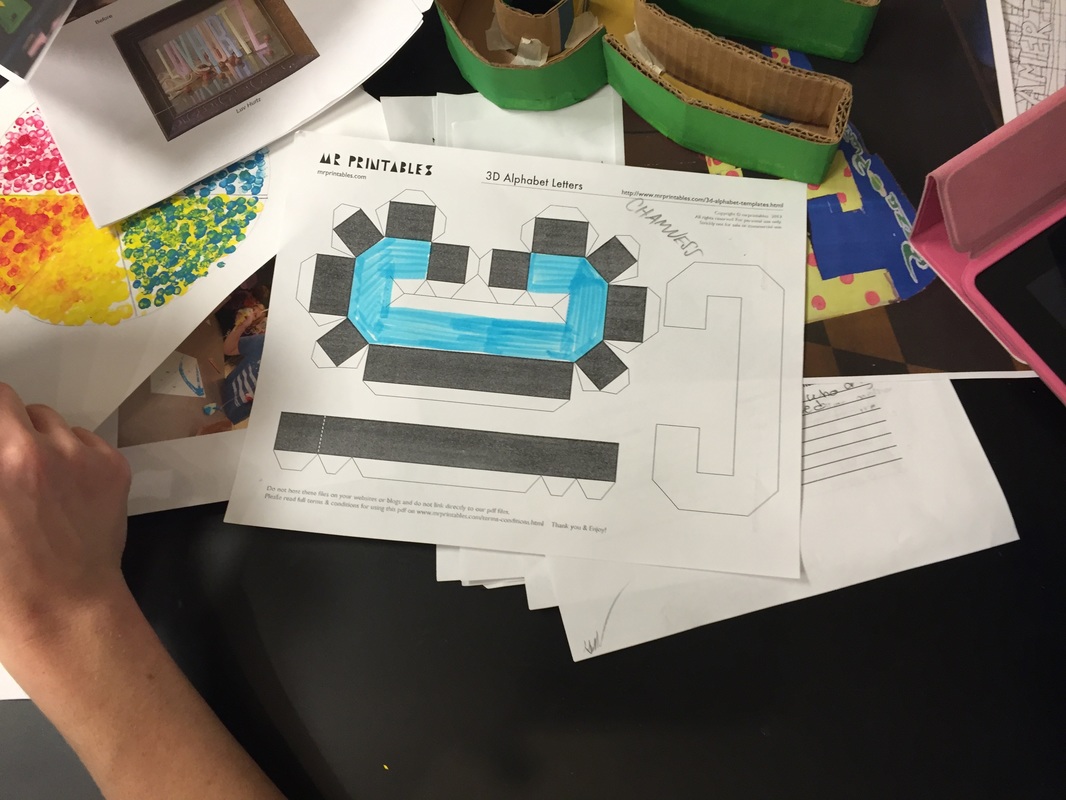
Blake’s classes also explore the transformation of text to image through a group design project. He first showed his students artists that use text: Wayne White, Ryan Everson. He then has students complete an exercise that uncovers the personal etymology of a word. Students then explore construction techniques (pictured)  and color. Students then create their word from cardboard and paint them. The resulting artifacts are impressive and more robust than if students had simply constructed a letter or word devoid of meaning. 
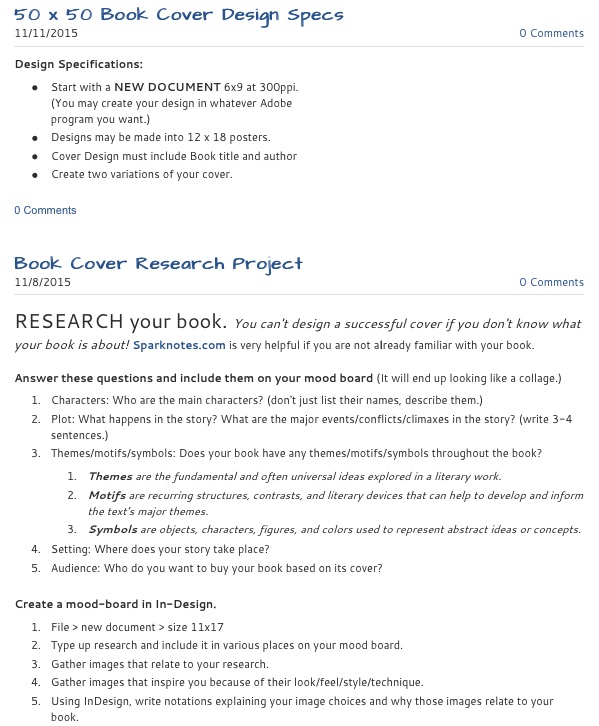
Jody’s design class participated in Recovering the Classics, a design initiative aimed at acquainting youth today with classic novels. Included below is the spec. sheet that Jody provided her classes. With the assistance of her student teacher Kevlyn, Jody’s students learned about the research that goes into effective design, the interplay that is needed between the design and object, and the gist of a classic novel to boot. 
Scaffolding learning provides avenues for reflection, metacognition and feedback. Young artists grow successfully as independent learners with teacher led support systems. 

There will not be a meeting in January, so we will meet on February 2nd — Groundhog’s Day. Enjoy your winter break!!

​p.s. MAKE ART!
p.p.s. The 5th annual TAB conference is January 16-17 at Redline. 
​p.p.p.s. Katie Taft will be a part of the Access Gallery’s exhibition on January 9th.

Wayfinding

“…every place holds within it memories of previous arrivals and departures, as well as expectations of how one may reach it, or reach other places from it. Thus do places enfold the passage of time: they are neither of the past, present or future but all three rolled into one. Endlessly generated through the comings and goings of their inhabitants, they figure not as locations in space but as specific vortices in a current of movement, of innumerable journeys actually made.” 
                          Tim Ingold –The Perception of the Environment: Essays in Livelihood, Dwelling, and Skill
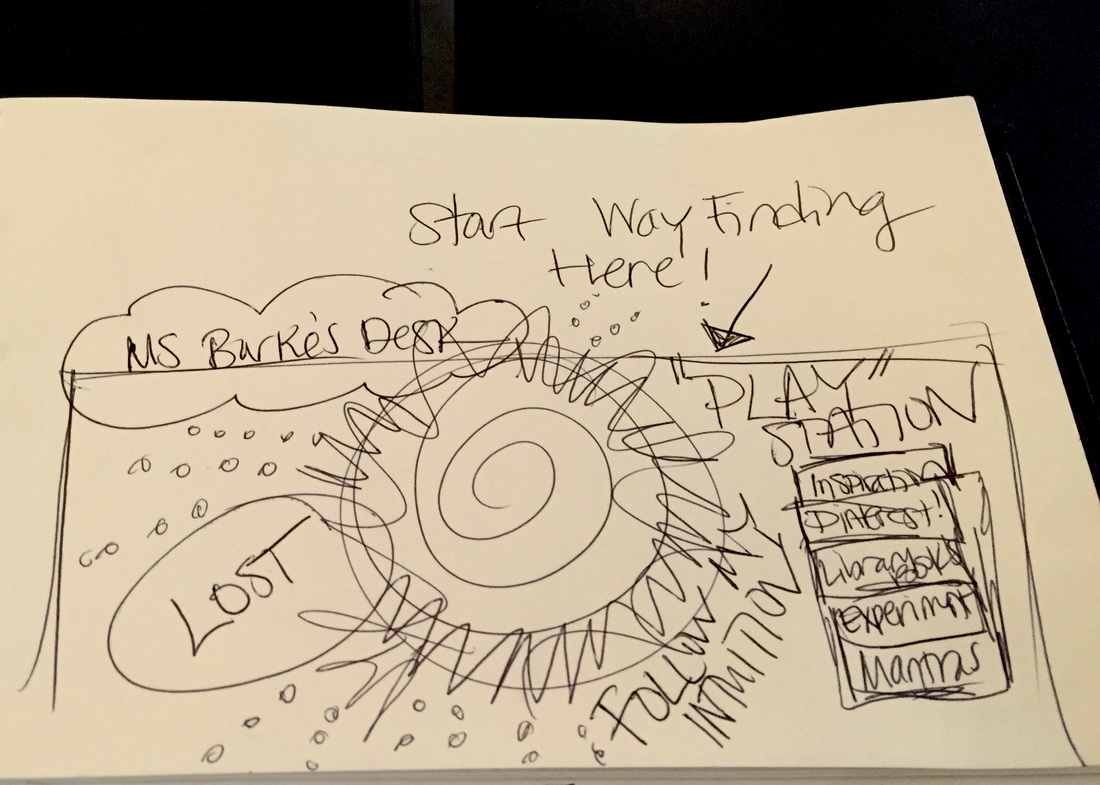
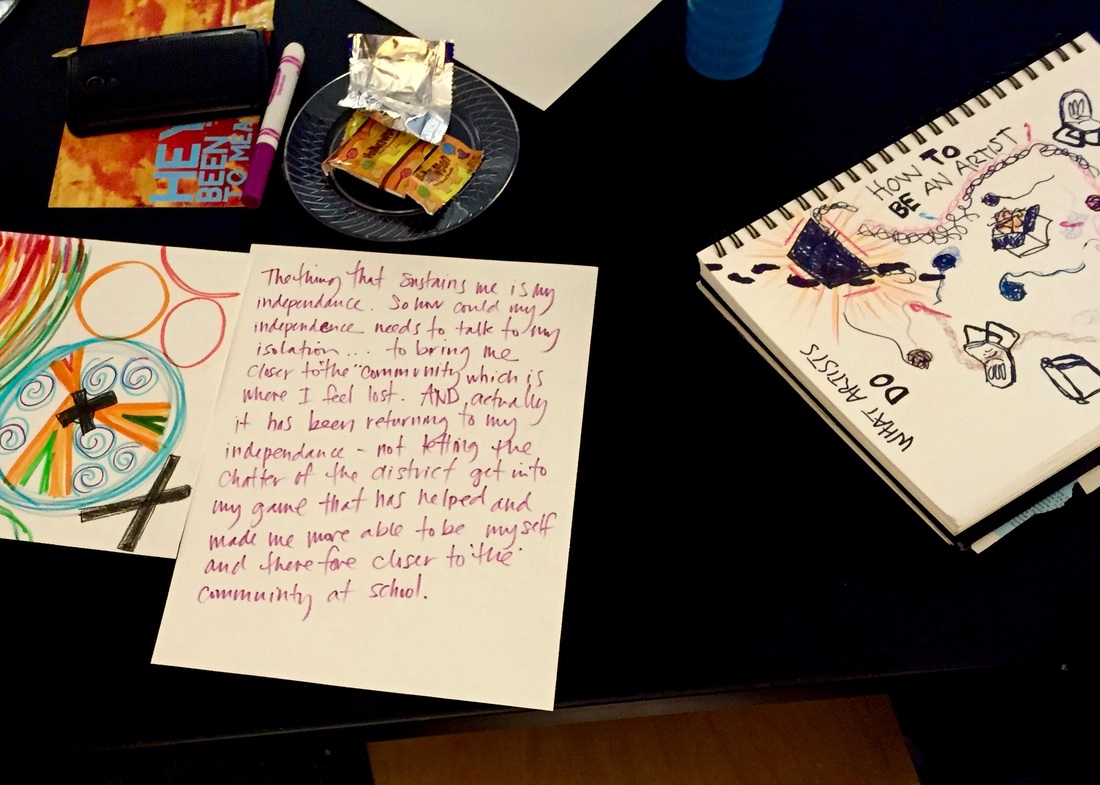
Wayfinding exploration — Teachers were asked to: 1) draw their classrooms
2) trace the path on a day when they ‘lost’ their            
      way
3) create a way to bring the thing that sustains            
     them into the space where they became lost. 
This activity demonstrates:
1) Wayfinding through Everyday Practice: Being is
      the practice
2) 
Wayfinding through Memory Marking
3) 
Wayfinding through Belief Systems Using
​     Self-Publishing

We investigated Wayfinding through the lens of these artists: J Morgan Puett, Chiharu Shiota, and Lisa Anne Auerbach.
What is the appeal/usefullness of wayfiding?
How does wayfinding shape/inform understanding?
Homework:
Please bring student work that demonstrates scaffolding to our next meeting, Tuesday December 1st

What Sustains You?

THEME
 What is keeping you alive, inspired, engaged, and makes you want to teach, create, and imagine this year?

Is it a student? Is it an artist that inspires you? Is it a breakthrough in your teaching?

It might be a line of inquiry in your art making.
It could be a book or an academic pursuit.
It might be achieving clarity over a new concept or letting go of clarity over a well-worn concept.

It might be a combination of these, or others, or something else… 

What keeps you going? What keeps you up at night? What keeps you here?

(Thanks for your help with this Anne!)

Homework…
1.)Bring (and be ready to share) any writing, sketch, mind-map, brain-stormy  ideation artifacts based on the guiding question:  What is keeping you alive, engaged, and inspired as an artist-teacher?

​Rachel D will be presenting contemporary artists that share a similar theme!!

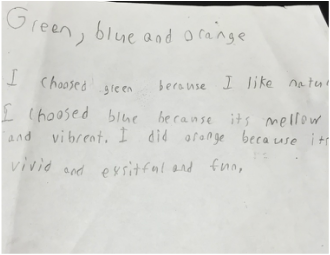
Blake shared his self-portrait project that explores the myriad meanings of color. Students first practice with proportion, then create a practice drawing, before finally crafting a painted portrait. The students, like the one at left, must reason their color choices. 
Recap: Thank you for bringing in your students work. Work was shared through a “game” called “Seeing, Noticing, and Wondering” where the presenter silently listens while others uncover what the lesson may be based solely on the artifact provided. 

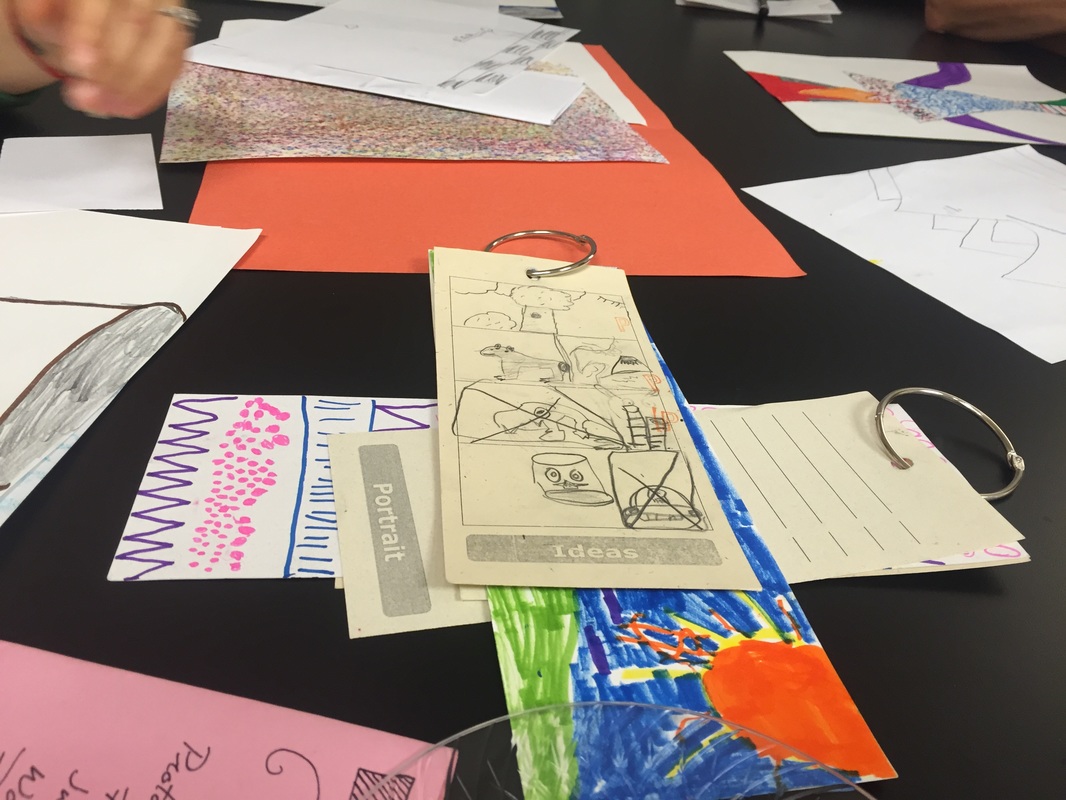
Kat’s flip ring tool books serve as interactive, hand-built, and autobiographic tools for students in her TAB classroom. Her students create these throughout the year, demonstrating their learning while generating a reference tool for future use.

CAEA is quickly approaching. Vanessa, president-elect, reported that there are still a few one-hour spots available on Saturday if you’d like to lead a workshop. I’m always hearing wonderful things about the conference, so if you haven’t gone you should go. If you need more incentive, several TLP members will be presenting at the conference. 
The conference runs 11.12-15 and you can find all of the information here: CAEA

Welcome [back]!!

As another school year begins, so do our meetings. We will be meeting on the 1st Tuesday of each month, focussing our attention, through action research, on issues that affect the teacher student paradigm.

Picture

We also planted a seed: Our 2nd biannual exhibition will be next spring in conjunction with CAEA’s exhibition. Our initial theme suggestion is Radical Compliance, a term coined by Arnold Aprill. (click) for an article about the false dichotomy of direct/integrated arts instruction. Perhaps you have thoughts regarding the proposed theme? You should share them with me and I will make your voices heard. Perhaps there’s another phrasing that encapsulates the dichotomization of arts education in the CDE, or perhaps there’s some other binary opposition we should explore? This show is ours, so please contribute to the thematic exploration. 

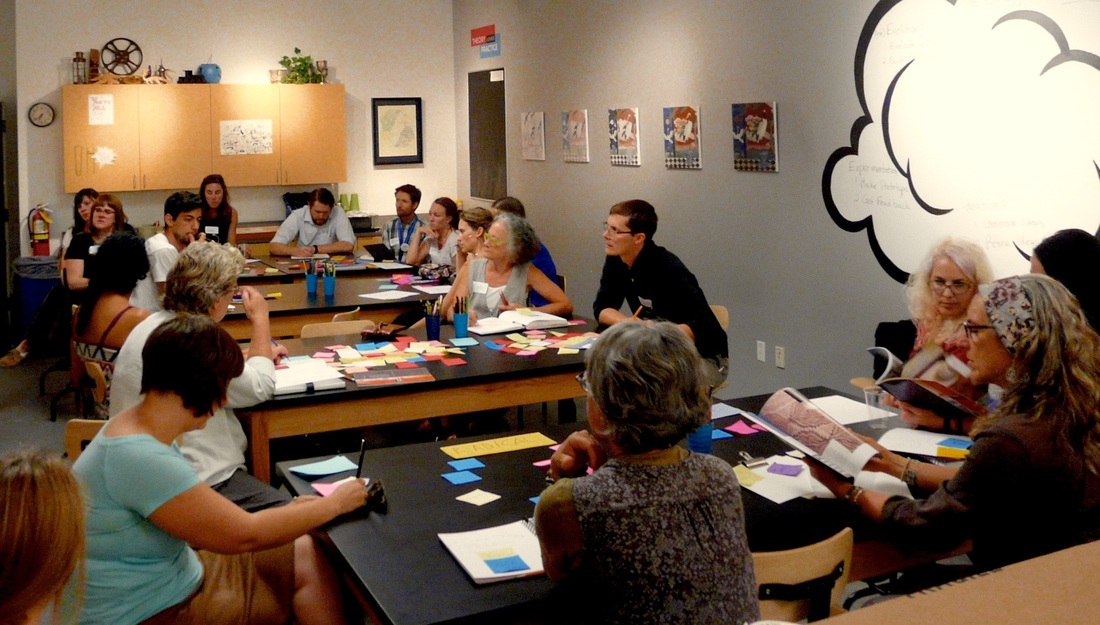
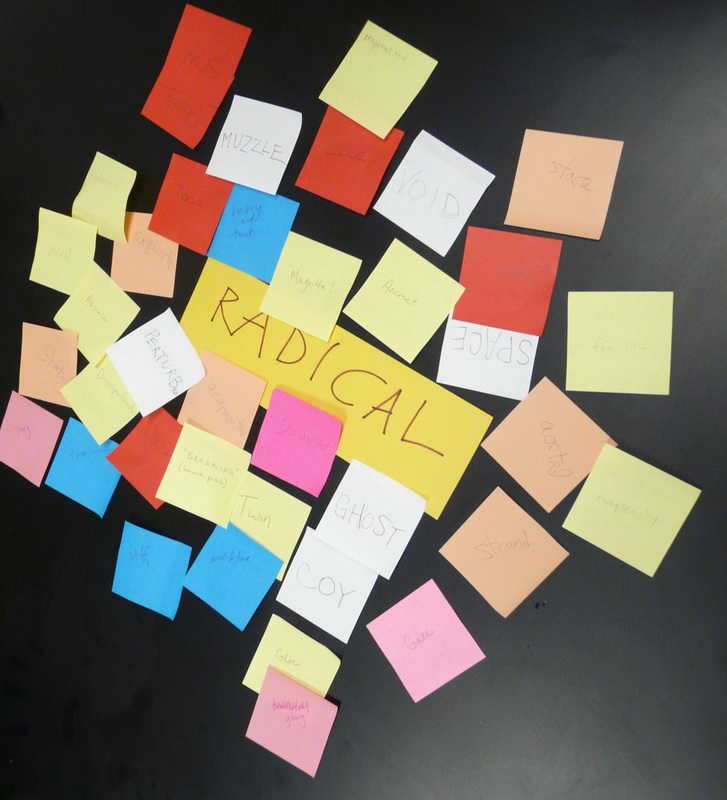
Our introductory meeting began with snacks and small conversation before our evening’s activity began. We were instructed to venture into the gallery and spend some time with A New Fine Line.  While taking in this incredible exhibition of Chinese art, we wrote automatic one-word responses to our interactions with the art. We then took these responses and used them to create word banks in small-ish groups. These word banks were then grouped into pairs, sparking conversation about the reasoning behind the pairing which informed the group about everyone’s thinking—it’s a sneaky, successful icebreaker. We then ungrouped the pairs and sorted the words into two groups: Radical and Compliance. We then had a walk-about to see what each group had come up with. Finally, we grabbed one word from each category and created a sketch to embody what that pairing means to us. Such an activity works to foster communication, reveal more about ourselves than our intro does, and foster camaraderie amongst the entire group. 

Picture

Our Next Meeting will be October 6th. We will meet at the Center for Visual Art and we will have fun.

AssignmentPlease remember to bring some of your students’ work with you.  If you could bring in three(3) student generated examples of one project to share: one that meets,  one that exceeds, and one that is sub-par. *only bring these if you have them and are willing to share*


Autumn come she may…

Greetings Theory Loves Practice,
I hope you are all well and that summer treated you kindly. The CVA has some magical work hanging this fall and I hope to see many of you and your students here. A New Fine Line features 9 artists from Beijing. The artists will be doing demonstrations on August 27th at 5 pm. I think it is going to be a really special evening!

Theory Loves Practice will work towards our own exhibition this year as well. Three years ago the CVA invited TLP to create an exhibition. We took the invitation and created work in response to the concept of “data.” The work was beautiful and told a compelling picture of the ways in which data is both under and over utilized in education.

The upcoming spring exhibition will be ours to shape. Please come to the first meeting September 1 at 5:30 p.m. to be part of the conversation and give direction to our 2015 inquiry.

We will continue to meet on the first Tuesdays of each month and continue to be sad that the date does not work for all. Please note that we will meet a bit earlier this year from 5:30-7 at the CVA (965 Santa Fe). There is free parking and treats to eat so come on by! This community welcomes new people. Please bring any new colleagues you think might contribute to our third space.
Talya

Spring sketchbook exp. pt. iii

Picture

Just to Recap: Over the course of the 3 previous sessions we have been focussing on the Sketchbook as an implement for learning and a record of visual thinking.

Each session included:

  • sharing student sample sketchbooks
  • participating in a variety of sketchbook practices taught by peers
  • reflecting on the process of student thinking and making the thinking visible

The sessions were guided by these principles highlighted in Making Thinking Visible:

  1. Identifying Patterns and Making Generalizations(2/10)
  2. Generating Possibilities and Alternatives(2/10)
  3. Evaluating Evidence, Arguments and Actions(3/3)
  4. Formulating Plans and Monitoring Actions(3/3)
  5. Identifying Claims, Assumptions and Bias (4/7)
  6. Clarifying Priorities, Conditions and What is Known (4/7)


Here’s what we investigated at our most recent meeting. 

O.P.T.I.C. investigation

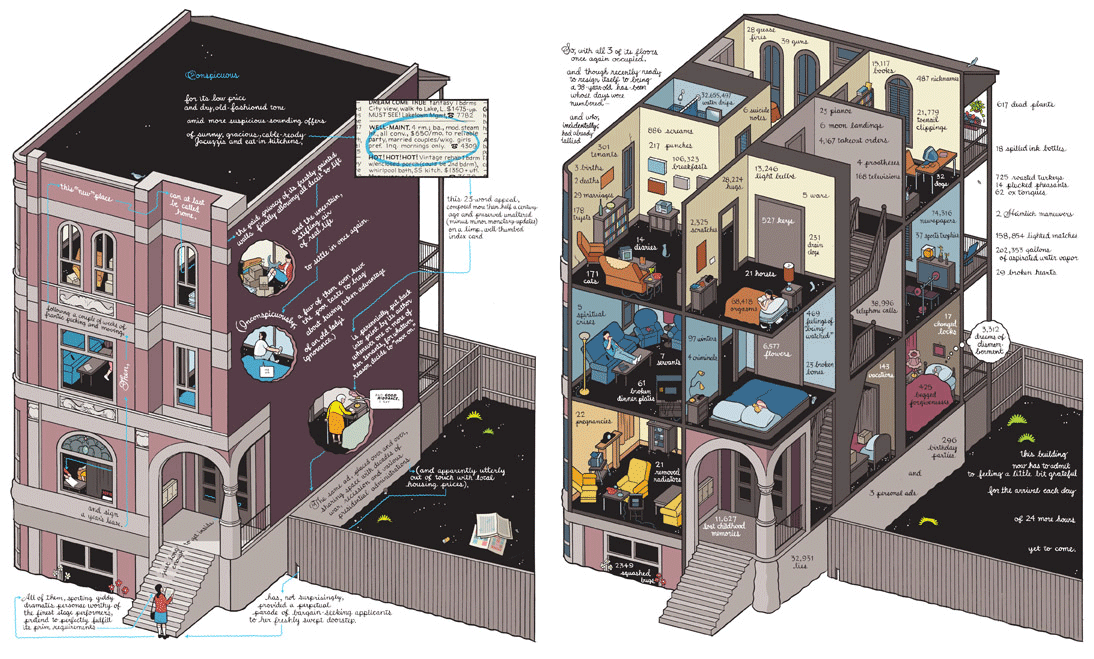
Using the OPTIC method of inquiry, we examined an artwork by Chris Ware, a graphic artist, from his book Building Stories. Leveraging the appeal of graphic novels to teach students an impactful way to interact with artwork proves to be fruitful indeed. The conversation that stemmed from using this method of inquiry was rich, candid, and on topic, leading me to believe that there may be something to this OPTIC investigation.
This method of investigation was presented by Diane . At her school the AVID program, a socratic based teaching method, is utilized to benefit students that need assistance succeeding in our education system. We were presented with the OPTIC method of interacting with artworks. This graphic organizer scaffolds the user’s investigation by prompting different access points to the artwork.The prompts are:  
Overview: What is the main idea/theme of the art?
Parts: What are the formal elements at work in the art?
Title: How does the title help explain the artwork?
Interrelationships: How does this artwork connect to your experiences?
Conclusion: A summary of the interconnections of the previous questions

Evolving the sketchbook
 into the digital realm

Jody presented the sketchbook of the future, today! Leveraging the tech and machines that draw today’s students in, Jody has evolved the sketchbook for her digital media students.    
   “Digital idea journals can help make art-making more meaningful. Online website and blog technology helps capture research, show connections, and document learning–enhancing the creative process.”

Picture

Adding layers of digital research to the art-making process can create a more meaningful experience for the student and give the teacher consumable, quantifiable  evidence of the learning and grappling that students are doing. “Used in the classroom, digital journals can actively engage students to outline goals, demonstrate progress, express self-reflections, and present influences and inspirations.”  
With the proliferation of available FREE digital journal/sketchbook sites,  digital journaling can be brought into the classroom with confidence. Jody relayed sites that she uses with her students:
Padlet lets you create walls of text and image as you research online, just drag and drop.
Visual thesaurus presents word definitions in a fun, playful manner.
Weebly is a user-friendly site builder, from blogs to digital galleries.
Pinterest is an easy way to collect and organize all those interesting things we come across while searching online.
Inkflow is an app that combines digital drawing, touch-screen writing, and digital images into one powerful digital journal.
I’m sure there are others out there we’re not familiar with, so let us know…

NAEA in nola

A few of our members went to NAEA in New Orleans (jealous) and had many wonderful things to say about the conference and the city. Hopefully I can cajole those who went to share their experiences with us. Share them HERE

HOmework for may 5th

Research your name:
Why are you named what you are? 
What does your name mean/stand for?
**Bring some collage-ables**
The activity for our next meeting comes from State of Play–a method of teaching visual thinking through play:
     
  “Play is an organized activity that is disguised as something fun and/or competitive. The form of play can be very structured (with rules and deep strategies, as in chess) or more loosely dened and open- ended (as in playing with blocks). 
In a state of play, teaching and learning flow naturally, opening up opportunities for exploration and experimentation by every person in the room. 
Play is something students understand.” –Anthony Fontana

*If you’d like to read more, click this: State of Play