Spring session finale

We’ve done it! We’ve completed another fruitful session of Theory Loves Practice. Thank you so much to every teacher that made time in their busy schedules to come out and contribute, participate, and be present in this cohort of educators that are continuing to reify their pedagogy and evolve their epistemology. While we may all come from different educational settings with different styles of teaching, we, through this investigative practice, are reaffirming the plasticity of our practice, of knowledge, and of education en masse. (Editor’s note: sorry for prattling on, but you guys rock!)

Just to recap…

We spent time investigating the role that the sketchbook plays in the educational paradigm through the lens of: these principles highlighted in Making Thinking Visible:

  1. Identifying Patterns and Making Generalizations(2/10)
  2. Generating Possibilities and Alternatives(2/10)
  3. Evaluating Evidence, Arguments and Actions(3/3)
  4. Formulating Plans and Monitoring Actions(3/3)
  5. Identifying Claims, Assumptions and Bias (4/7)
  6. Clarifying Priorities, Conditions and What is Known (4/7)

It was a fruitful venture in that 

Spring Sketchbook EXp. Part II

Picture

Just to Recap: Over the course of 4 sessions we are focussing on the Sketchbook as an implement for learning.

You can drop in on any session this spring without feeling that you have missed anything as each session is designed to stand on its own.  The next one is 04.07.2015

Each sessions will include:

  • sharing sample student sketchbooks
  • participating in a variety of sketchbook practices taught by peers
  • reflecting on the process of student thinking and making the thinking visible

The sessions will be guided by these principles highlighted in Making Thinking Visible:

  1. Identifying Patterns and Making Generalizations(2/10)
  2. Generating Possibilities and Alternatives(2/10)
  3. Evaluating Evidence, Arguments and Actions(3/3)
  4. Formulating Plans and Monitoring Actions(3/3)
  5. Identifying Claims, Assumptions and Bias (Upcoming)
  6. Clarifying Priorities, Conditions and What is Known (Upcoming)

“Fish Frenzy”
In exploring  principle 4, “Formulating Plans and Monitoring Actions,” Deb shared a weekly homework assignment from her high school art class. This recurring assignment begins with a prompt, i.e. fish frenzy. Students then have one week to complete an artwork in response to this. Deb provides students with an Idea Generator List: 

Picture

Students work from the impetus of the prompt and examine their thinking through the lens of the list, inspired by Rouke’s Art Synetics, and create a thoughtful, engaging artwork. The prompt and list work in unison to scaffold student ideation while removing the impediment of generating a “new” idea that so many students struggle with.  As part of her sketchbook demonstration, Deb had us take ten minutes to experience this process and you can see our interpretations below.

Picture

Our 10 minute fish frenzies

“Artist’s Statement”
Addressing  principle 3, “Formulating Plans and Monitoring Actions,” Erica introduced us to her plan for teaching students to write artist’s statements. Erica demonstrates the breadth of information that can be covered by providing her students with the artist statements of various prominent artists. Erica’s generative approach addresses the daunting task of writing such a statement by dissecting and chunking the process. Erica gives her students a note-catcher that builds a word bank for students to use while creating their statements. This building is done by having students record the first words that come to mind about topics such as goal, influences, and form of work, and then use a thesaurus to further build the language that will be used to speak about their art. 
        By having students draft an artist’s statement, Erica is not only satisfying the GLE “I can explain my thinking in detail about how and why I create artworks,” but she is helping students to find their voice, to think  purposefully and intentionally, and to reflect upon what they created. 
Next Meeting…We will be grappling with identifying claims and bias, and clarifying priorities, conditions, and what is known. April 7th at 6pm. 

Spring Sketchbook Experiementation

We will take 4 sessions to focus on the sketchbook as a research document, a home for the rituals of making and an expansive documentation of learning. You can drop in on any session this spring without feeling that you have missed anything.  Each session can stand on its own.
Each sessions will include:

  • sharing sample student sketchbooks
  • participating in a variety of sketchbook practices taught by peers
  • reflecting on the process of student thinking and making the thinking visible

The sessions will be guided by these principles highlighted in Making Thinking Visible:

  1. Identifying Patterns and Making Generalizations
  2. Generating Possibilities and Alternatives
  3. Evaluating Evidence, Arguments and Actions
  4. Formulating Plans and Monitoring Actions
  5. Identifying Claims, Assumptions and Bias
  6. Clarifying Priorities, Conditions and What is Known

We need your help moving forward!

Our March session will be led by a few of you. We are looking for 2 volunteers to lead a sketchbook exercise that addresses one or both of these elements of learning from Making Learning Visible:

1.Evaluating Evidence, Arguments and Actions
2.Formulating Plans and Monitoring Actions

Maybe you have a really great way to encourage research or planning? Please let me know if you would like to lead.  I can provide all the materials. 5-20 minutes.

We will also take time to really share some more student sketchbooks so please borrow from your students if possible!. 

A/R/Tography, Interstitial Identity and Diving into our fall project

On Tuesday our community was joyfully reconnected to begin our 2014 Fall work.  Lively conversation ensued when we were prompted to consider the multiple professional identities of art educators.  Given the opportunity to share, each of us reduced our definitions to a mere three words but those three words gave us a glimpse into the complexity of our self-image.  While others might see art teachers we see a diverse network of worker bees, queens, philosophers, cooks, sociologists, dreamers, therapists, artists, etc.  Perhaps most notable is the number of TLP members who also see themselves as scholars.
Sarabeth will be leveraging our diverse identities for her own scholarship.  As she completes her PhD we will walk beside her in support of her research.  Stay tuned for more.

Sarabeth’s presentation to introduce the concept of scholarly work in art education can be found here.

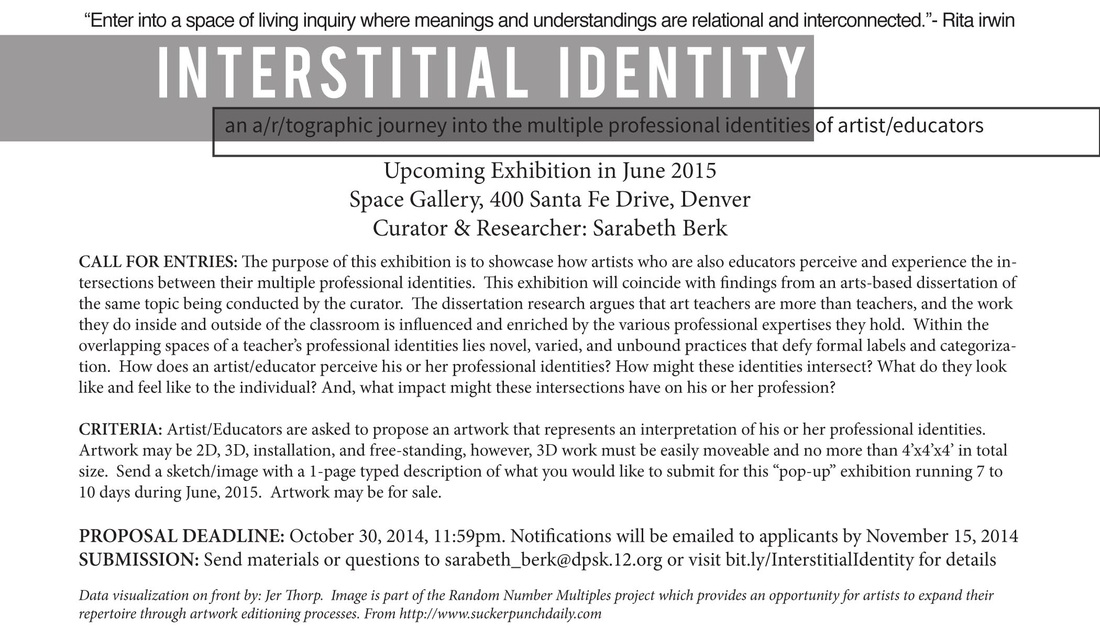
We are also excited to share a call for entries specific to art educators!

Concurrent with her research, Sarabeth will be curating an exhibition!

4/9/14

A big thank you to Sandy Lane for sharing a journey to Spain with us.  Sandy, professor of drawing and exhibiting artist in the CVA’s Making Contact exhibition, took us on a guided journey through imagery rich writing exercises.  It was a beautiful experience and absolutely applicable to our work with kids.
Here are a couple of the writing prompts…images to come soon!

  • Which of your senses have you neglected?  Write an apology to that sense.
  • Think about the home you lived in that has become the baseline that you compare all homes too.  Use descriptive language to write about that home.
  • Avert your eyes and draw blindly on a piece of paper next to you in response to the emotions of the exercise above.
  • Draw a map of that home.


1/7/14

Really wonderful crowd this month at the CVA.  It was great to have a few new folks to participate in our conversations.  Thank you to Rachael and Erin for sharing student work.  We focused our conversations this session on the looking at student work protocol.  I think I speak for everyone when I say that there are take aways for us all and not exclusively the teachers whose work we are looking at.  The group spending time with a semester-long sketchbook project developed new ideas about assessment in the face of ongoing growth.  In some respects the sketchbook assessment would always be a formative assessment which has the potential to be unsatisfying to both the teacher and the student.  In our case we thought perhaps a postcard entry to be mailed whenever the artist finds inspiration would be a potential way to continue the intimate dialog.We also spent a few moments in the gallery with the work from Cross Currents exhibition.
See you all again in a month.

10/2/13

Hiya!Last night was fun!  Thanks to everyone who made it out.  We began two new projects.  See below for details:

Curriculum MashUp is a call for participation utilizing the format of dialog on paper to create a library of ideas through collaborative engagement. As a process based call for participation collaborators would build up, not edit down content, so that the ideas developed are able to grow into layers of possibilities that can be utilized as needed. Those interested in participating would submit a lesson plan on a sturdy sheet of paper that can fit into a 9×12 manila envelope. I use the term lesson plan loosely as the document needs to only reference an idea for instruction that your curious about. It can be a simple question like: “How can I blend critique into my curriculum so my students use it” or maybe it is a lesson that you want to breath new life into. The document you submit would then be sent to other community members who would then add to the ideas on the page using various 2-D techniques and processes. When your conversation with the idea sends send it back in to Curriculum MashUp and the material will be sent out again. This process will continue until the document is saturated with ideas. The completed MashUp will be scanned and posted. The original works will then be archived in books that can be checked out of the MashUp library. Inquiries and submissions for the MashUp should be directed to Rachael Delaney at [email protected]

Looking at Student Work Protocol (adapted from National School Reform “Tuning Protocol”)
Introduction (1 minute) Facilitator introduces the protocol
Presentation (5-10 minutes) Presenter shares the context (without a lot of images) for student work and what questions they have about the work and/or what feedback they would want from the group.
Clarifying Questions (2 minutes) Participants asks for fast, factual clarification.
Examination of Student Work (10 minutes) Participants examine the work through the presenter’s question/feedback-request lens/ 1 minute silence reflection on responses (gather thoughts on sticky notes)
Feedback (15 minutes) Participants share feedback while presenter is silent, taking notes.
Reflection (5 minutes)Presenter speaks to comments and questions of his/her choice while participants are silent. This is not a time to defend oneself but a time to reflect aloud on ideas or questions that seem particularly interesting.
Debrief (2 minutes) All write feedback of the protocol itself on post-its for TLP folks.
Next Meeting At CAEA Fall Conference 8 am Friday in the Copper Top at Beaver Run, Breckenridge, CO

9/11/13

We all left the CVA incredibly inspired to rock the boat and make the world a better place through art.  It was a pleasure to share this event with some of the TLP crew!  This note from Anne seems to sum it up best:

As I was listening and viewing Swoon’s incredible work on the streets, in the ocean, and in Haiti, I kept thinking….She exemplifies what we teach our students on our best days:  imaginative tinkering, inventive citizenship, synthesizing  worlds, joyful collaboration, agency, chutzpah, and compassion. 

And I kept thinking about what she said in the beginning…When I was 10 years old my mom signed me up for an art class and suddenly I knew that that was the space where I knew I could be safe and be myself. Swoon’s teacher in that class isn’t famous, but her work was absolutely part of “the growing good of the world” and her effect on Swoon was “incalculable.”  I don’t expect us to have hidden lives or rest in unvisited tombs, but this quote by George Eliot keeps me cognizant of the significance of our choice of the profession of teaching. 

“And Dorothea..she had no dreams of being praised above other women. Feeling that there was always something better which she might have done if she had only been better and known better, her full nature spent itself in deeds which left no great name on the earth, but the effect of her being on those around her was incalculable. 

For the growing good of the world is partly dependent on unhistoric acts and on all those Dorotheas who live faithfully their hidden lives and rest in unvisited tombs. (George Eliot, Middlemarch)